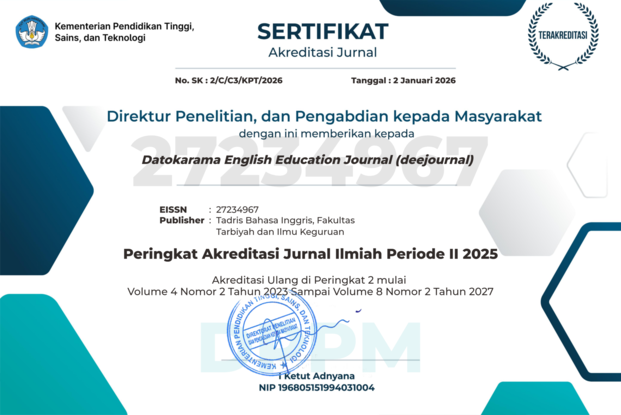
Examining English Learning Demotivation Level of Indonesian First-Year University Students: A Comparative Study

Abstract
Demotivation can undermine students’ engagement and persistence in English as a Foreign Language (EFL) learning, particularly during the transition to university, when first-year students encounter new academic and assessment demands. Understanding its sources is therefore important for supporting students’ adjustment and sustained engagement in English learning. The current study aimed to investigate the level of students’ demotivation in English learning, the dominant factors, and the differences based on gender and educational background. It focused on first-year students enrolled in an Islamic University in Madura that considers English as a compulsory and intensive course. This study was a quantitative research with a survey design. Demotivation questionnaires were adopted and modified from Sakai and Kikuchi (2009) and administered to 147 students through Google Forms. The findings revealed a moderate level of demotivation. Based on the reverse scale, in which lower scores indicate higher demotivation, test scores emerged as the most prominent demotivating factor (M = 3.03), followed by inadequate learning facilities (M = 3.16), learning contents and materials (M = 3.31), lack of intrinsic motivation (M = 3.33), and teacher competence and teaching styles (M = 3.50). A significant gender difference was found, with male students reporting higher demotivation (M = 3.10) than female students (M = 3.39), t(145) = 2.134, p = .035. In contrast, no significant difference was found across educational backgrounds, F(5, 141) = 1.068, p = .381. These findings highlight the importance of assessment experiences in first-year EFL demotivation and suggest the need for more supportive assessment practices during students’ transition to university English learning..
Keywords:
demotivation, EFL, first-year student, individual differencesCopyright
Copyright (c) 2026 Fithriyah Rahmawati, Ana Mae M. Monteza, Moh. Syafik

This work is licensed under a Creative Commons Attribution-NonCommercial 4.0 International License.
References
Adwani, P., & Shrivastava, S. (2017). Analysis of Factors Affecting Second Language Acquisition. International Journal of Social Sciences and Management, 4(3), 158–164. https://doi.org/10.3126/ijssm.v4i3.17247
Araújo, A. M., Assis Gomes, C. M., Almeida, L. S., & Núñez, J. C. (2018). A latent profile analysis of first-year university students’ academic expectations. Anales de Psicología, 35(1), 58–67. https://doi.org/10.6018/analesps.35.1.299351
Bush, C., & Peters, T. (2020). The Demotivated Employee: Helping Leaders Solve the Motivation Crisis That Is Plaguing Business. Advantage Media Group.
Deci, E. L., & Ryan, R. M. (2013). Self-Determination Theory: An Approach to Human Motivation and Personality. University of Rochester.
Dörnyei, Z. (2005). The Psychology of the Language Learner: Individual Differences in Second Language Acquisition (First, Vol. 29). Lawrence Erlbaum Associates, Inc. https://www.cambridge.org/core/product/identifier/S0272263107310061/type/journal_article
Dörnyei, Z., & Ushioda, E. (2021). Teaching and Researching Motivation (Third Edition). NY: Routledge. https://www.routledge.com/Teaching-and-Researching-Motivation/Dornyei-Ushioda/p/book/9781138543461
Gao, L., & Liu, H. (2022). Revisiting students’ foreign language learning demotivation: From concepts to themes. Frontiers in Psychology, 13, 1030634. https://doi.org/10.3389/fpsyg.2022.1030634
Guo, W., & Zhou, W. (2021). Relationships Between Teacher Feedback and Student Motivation: A Comparison Between Male and Female Students. Frontiers in Psychology, 12, 679575. https://doi.org/10.3389/fpsyg.2021.679575
Hassaskhah, J., Mahdavi Zafarghandi, A., & Fazeli, M. (2015). Reasons for demotivation across years of study: Voices from Iranian English major students. Educational Psychology, 35(5), 557–577. https://doi.org/10.1080/01443410.2014.893557
Hassel, S., & Ridout, N. (2018). An Investigation of First-Year Students’ and Lecturers’ Expectations of University Education. Frontiers in Psychology, 8, 2218. https://doi.org/10.3389/fpsyg.2017.02218
Jannatussholihah, S., Ashadi, & Andriyanti, E. (2022). “My Grades Are Always Equal to Standardized Critetria”: Discovering EFL Learners’ Motivation Outside Formal Classroom. JEELS (Journal of English Education and Linguistics Studies), 7(2), 347–369. https://doi.org/10.30762/jeels.v7i2.218
Kikuchi, K. (2015). Demotivation in Second Language Acquisition: Insights from Japan. Multilingual Matters. https://doi.org/10.21832/9781783093953
Kim, S. (2015). Demotivation and L2 Motivational Self of Korean College Students. English Teaching, 70(1), 29–55. https://doi.org/10.15858/engtea.70.1.201503.29
Kostromitina, M., Naismith, B., Burstein, J., & Plonsky, L. (2025). Beyond GPA and language proficiency: A systematic literature review of international students’ academic success factors. Review of Education, 13(2), e70089. https://doi.org/10.1002/rev3.70089
Li, C., & Qian, J. (2017). Investigating Changes in Demotivation among Chinese EFL Learners from an Activity Theory Perspective. International Journal of English Linguistics, 8(1), 44. https://doi.org/10.5539/ijel.v8n1p44
Linnenbrink-Garcia, L., Patall, E. A., & Pekrun, R. (2016). Adaptive Motivation and Emotion in Education: Research and Principles for Instructional Design. Policy Insights from the Behavioral and Brain Sciences, 3(2), 228–236. https://doi.org/10.1177/2372732216644450
Liu, H., & Zhong, Y. (2022). English learning burnout: Scale validation in the Chinese context. Frontiers in Psychology, 13, 1054356. https://doi.org/10.3389/fpsyg.2022.1054356
Marchak, T. (2025). Understanding and Increasing Motivation to Study English among Higher Education Students Majoring in Public Management and Administration. Вісник Науки Та Освіти, (9(39)). https://doi.org/10.52058/2786-6165-2025-9(39)-86-94
Nasution, L. R., Sandi Pradana, Iis Maisaroh, Selvi Ratna Sari, & Sri Andayani. (2025). Negotiating Faith, Future, and Foreign Language: A Psychological Inquiry into English Learning among Non-English Major Students at an Islamic University. Indonesian EFL Journal, 11(2), 501–512. https://doi.org/10.25134/ieflj.v11i2.11901
Ortega-Auquilla, D., Sigüenza-Garzón, P., Chumbay, J., & Heras, E. (2023). Motivation in English Learning at University: A Mixed-Methods Study Investigating the Perceptions of Different Stakeholders*. International Journal of Learning, Teaching and Educational Research, 21(12). https://www.ijlter.org/index.php/ijlter/article/view/6183
Pekrun, R. (2024). Control-Value Theory: From Achievement Emotion to a General Theory of Human Emotions. Educational Psychology Review, 36(3), 83. https://doi.org/10.1007/s10648-024-09909-7
Perera, K. D. R. L. J. (2021). Students’ Perceptions of School-Related Conditions Impacting Their Motivation and Engagement in Learning. Open Journal of Social Sciences, 09(09), 353–377. https://doi.org/10.4236/jss.2021.99025
Ranjha, M. (2021). Demotivating Factors in the Foreign Language Learning: An Analysis of the Past Studies. Pakistan Social Sciences Review, 5(III), 325–338. https://doi.org/10.35484/pssr.2021(5-III)24
Ribeiro, L., Rosário, P., Núñez, J. C., Gaeta, M., & Fuentes, S. (2019). First-Year Students Background and Academic Achievement: The Mediating Role of Student Engagement. Frontiers in Psychology, 10, 2669. https://doi.org/10.3389/fpsyg.2019.02669
Saifullah, S. (2024). From English teachers’ perceptions: English learning demotivating factors for Indonesian University students. Cendikia : Media Jurnal Ilmiah Pendidikan, 14(4), 412–421. https://doi.org/10.35335/cendikia.v14i4.4870
Sakai, H., & Kikuchi, K. (2009). An analysis of demotivators in the EFL classroom. System, 37(1), 57–69. https://doi.org/10.1016/j.system.2008.09.005
Sari, D., & Junaidi, J. (2024). Engaging Beyond Academia: Exploring Non-English Majors’ Motivations for English Language Community Participation in Indonesia. Voices of English Language Education Society, 8(1), 139–149. https://doi.org/10.29408/veles.v8i1.25328
Shalabi, M. M., Madrasi, A. M. M., & Rashwan, A. K. (2025). “The Significance of Motivation in Education and Second Language Acquisition(SLA) Among L2 Learners” “أهمية الدافعية في التعليم واكتساب اللغة الثانية بين متعلمي اللغة الثانية.” المجلة العلمية بکلية الآداب. https://doi.org/10.21608/jartf.2025.396279
Sudina, E., & Plonsky, L. (2021). Language learning grit, achievement, and anxiety among L2 and L3 learners in Russia. ITL - International Journal of Applied Linguistics, 172(2), 161–198. https://doi.org/10.1075/itl.20001.sud
Ushioda, E. (2011). Language learning motivation, self and identity: Current theoretical perspectives. Computer Assisted Language Learning, 24(3), 199–210. https://doi.org/10.1080/09588221.2010.538701
Vasiou, A., Gkontelos, A., Vasilaki, E., Veloni, M., & Vaiopoulou, J. (2026). Early Trajectories into Academia: A Thematic Analysis of First-Year University Students’ Expectations and Experiences of Transition in Greece. Education Sciences, 16(2), 276. https://doi.org/10.3390/educsci16020276
Wallace, M. P., & Leong, E. I. L. (2020). Exploring Language Learning Motivation among Primary EFL Learners. Journal of Language Teaching and Research, 11(2), 221. https://doi.org/10.17507/jltr.1102.10
Wang, S., & Littlewood, W. (2021). Exploring students’ demotivation and remotivation in learning English. System, 103, 102617. https://doi.org/10.1016/j.system.2021.102617
Yuan, S. (2025). A Mixed-methods Study of Demotivating Factors in Business English Majors in China. SAGE Open, 15(1), 21582440251327529. https://doi.org/10.1177/21582440251327529
Zhou, W., Zhan, Y., & Jawing, E. (2023). Analyzing EFL learners’ demotivating factors in blended learning context. Frontiers in Psychology, 14, 1290034. https://doi.org/10.3389/fpsyg.2023.1290034